
I never thought twice about getting a vaccine. I recently got the flu vaccine, and while I was reading the information page (from the CDC) that the nurse had brought with her I saw section 4: Risks of a vaccine reaction. Under minor problems are the usual flu symptoms, something I can easily overlook because if I am getting the flu vaccine versus the flu they will both have a similar result in symptoms. Under more serious issues, the information sheet from the CDC highlighted Guillain-Barré Syndrome in 2/1,000,000 cases and an increased chance for seizures among children under 13.
That seemed alarming to me and in turn, had me thinking about the recent news about the resurgence of measles in the United States. As a proclaimed lover of science, when I think of vaccines I think: YES, get vaccinated. As a sometimes health nut I think: what if I am in the 1/500,000 who gets this Guillain-Barré Syndrome?
I learned about vaccines when I was in high school and again in college. Except, I couldn’t recall exactly what a vaccine was beyond “a weakened or killed virus” when I tried to explain it. There is more:
– Aluminum
– Thimerosal
– Sugar/gelatin
(according to vaccines.gov)
At first glance these seem like weird things to put in a vaccine. While sugar and gelatin seem relatively harmless to a child, Aluminum and Theimerosal seem dangerous.
A preliminary google search told me Aluminum is hazardous: leading to lung disease when inhaled in large quantities and brain/bone/kidney disease in children (from the CDC). Aluminum in HIGH QUANTITIES is bad. Small doses cannot be avoided as Aluminum is the third most abundant element in the Earth’s crust (according to Children’s Hospital of Philidelphia) and when I think of it I have been touching Aluminum foil all my life with no fear. That is because Aluminum is highly reactive. Highly reactive means that the Aluminum atom (Al) does not want to be alone and will combine with another element to make it less reactive and presumably less dangerous. Sodium is also highly reactive: see this video of pure sodium being tossed in water. We don’t think of table salt (sodium chloride: NaCl) as toxic and we use it every day as we use Aluminum often.
Thimerosal on the other hand, had me feeling nervous because of that big Hg on the molecule.
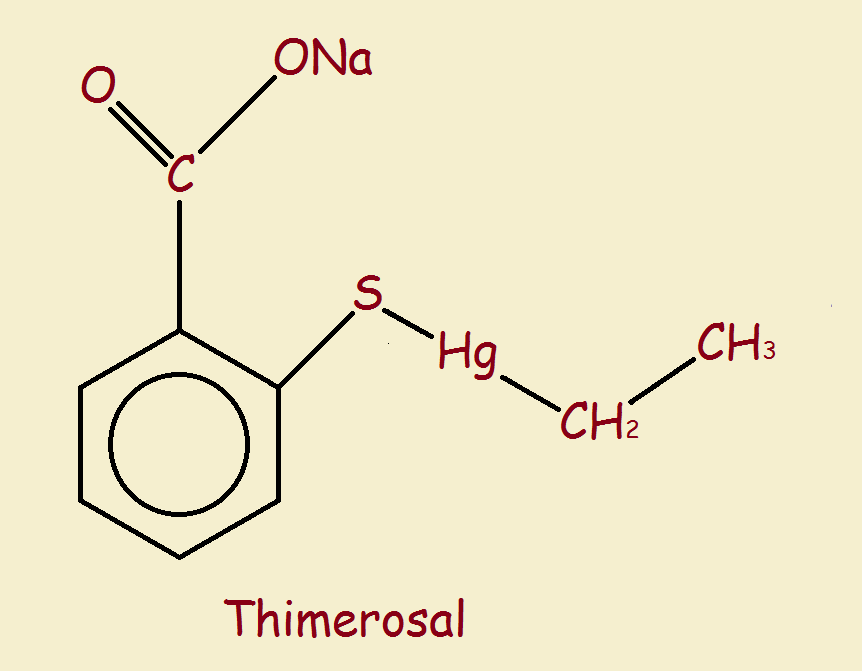
Thimerosal is added to vaccines as a preservative. The body will cut up and digest this molecule so that the mercury passes through the body. Reactions in the human body will cut Thimerosal between the Sulfer(S) and Mercury(Hg) creating ethylmercury the product on the left below:

According to the National Institute of Allergy and Infectious Disease ethylmercury is the more inert/safe molecule and methylmercury is the dangerous one. The danger of Methylmercury is partially due to the fact that is accumulates in the body. The body actively tries to excrete ethylmercury so it does not accumulate in the body (according to the World Health Organization).
I am not sure the necessity of Thimerosal in vaccines since vaccines can be created without preservatives. Since vaccines (like the measles vaccine) that do NOT have Thimerosal have 2 year shelf lives, I do not see the need for Thimerosal in the flu vaccines that will only be used for the season (<1 year). If it is a “preservative” how well it is really preserving the vaccine?
Luckily…
All vaccines routinely recommended for children 6 years of age and younger in the U.S. are available in formulations that do not contain thimerosal.
Ask your doctor about Thimerosal free vaccines for your children! If you do not need to inject a chemical in your child’s body, do not.
Vaccines are important, my problem is: not all components are essential.
There are some negatives to vaccines, like unnecessary Thimerosal, but in my opinion the positive aspects of vaccines are stronger than the unknown negatives. Vaccines prevent diseases like polio, measles, mumps, hepatitis. How do they do this?
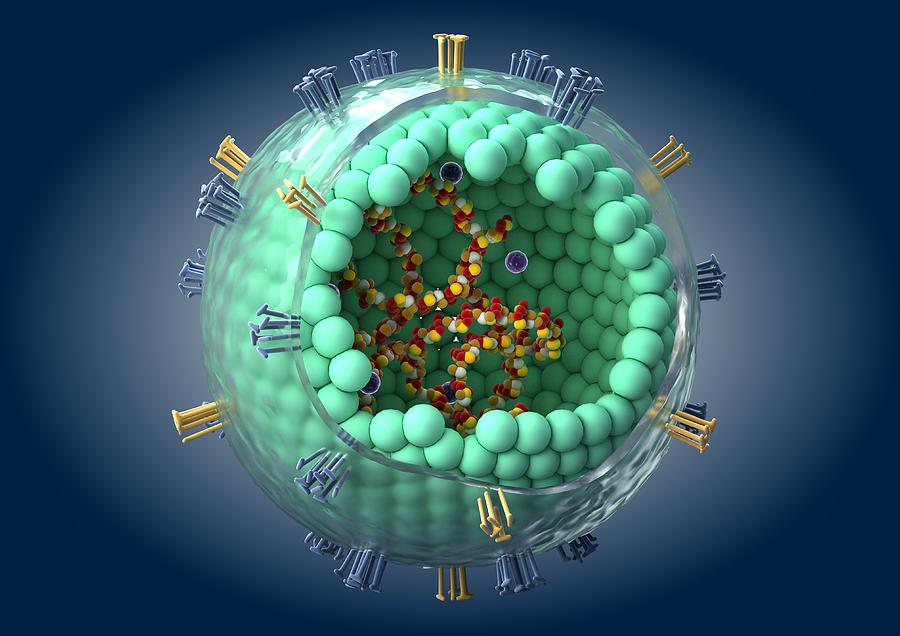
The actual active part of the vaccine: the weakened/deadened virus gives your child an extremely WEAKER version of the disease (ie. measles). Instead of cough, runny nose, inflamed eyes, sore throat, fever, and a red, blotchy skin rash, and DEATH the child instead feels fine or slightly fatigued for the day. If given a vaccine, the actively infecting part of the virus (the green bubbly outside: AKA the protein outside) is destroyed so the DNA or RNA inside is not able to infect the human. The blue and yellow chunks on the green bubbly outside of the diagram below are receptors made of proteins that play a role in finding weak points in the human body to bind to and infect the human. Because the yellow, blue, and green outer bits are destroyed the DNA/RNA (red/orange/yellow/white strands inside) are defenseless on their own. They cannot attack the human body or defend itself. The human body, noticing a foreign invasion of DNA and shredded outer protein bits, bind to the naked strands and destroy them. The immune system is able to retain its own memory, and now that it has seen this invading DNA will have a memory of how it can identify and destroy the invading DNA.
Point is: Try to get vaccinated. Vaccinate your children so your children do not die. Be informed. Ask your doctor questions but remember they are human and may not know the answer. It is important to get all the information you can. Ask for vaccines without Thimerosal. If your current doctor does not have one ask a different doctor there are millions of doctors.
I am always interested in hearing opinions. Why do you think vaccines are good? Why do you think they are bad? I would like to know your point of view. Leave a comment and we can have an open discussion.

 What is Going on in the World